
Technology & AI
The Next AI Revolution May Be Made of Concrete
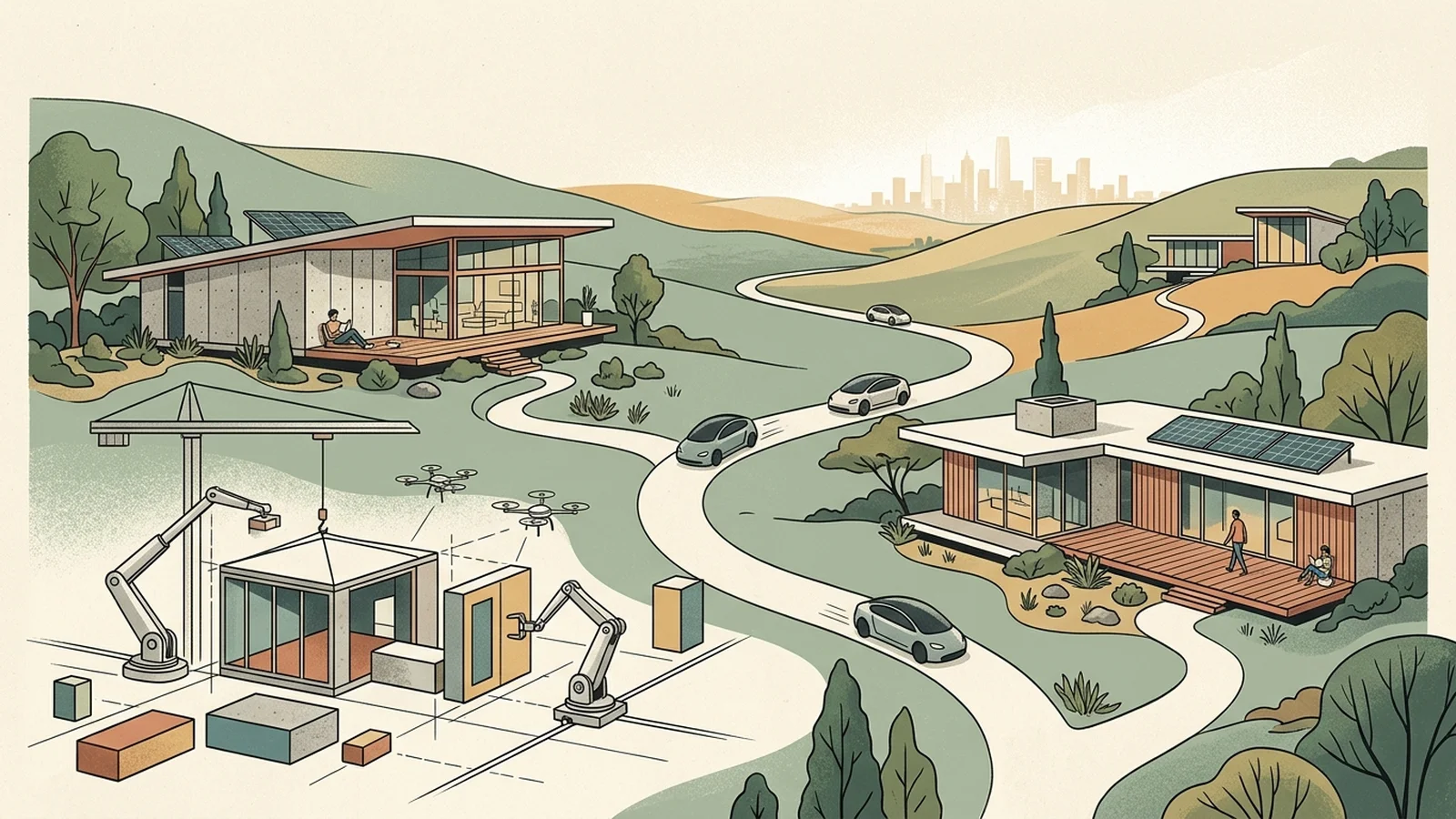
Self-driving cars could change where we live. Artificial intelligence could change how our homes are built. Together, they may reshape the economics of housing.
Your listening Queue & catch up
Add a story or build a catch-up queue to start listening.
The automobile helped create the American suburb. Its autonomous successor may help reinvent it.
For more than a century, the distance between home and work has shaped the price of land, the size of cities and the daily routines of millions of people. A house an hour from the office might offer more space, cleaner air and a garden, but it comes with a cost measured in time and attention. What happens when the driver no longer has to drive?
The answer may have less to do with automobiles than with the houses people choose to inhabit. Two technological revolutions are approaching from different directions: one promises to change the economics of transportation, while the other could transform the way homes are designed, manufactured, maintained and improved. Together, they raise an intriguing possibility: artificial intelligence may eventually reshape the physical geography of prosperity.
The passenger becomes the customer
The first autonomous vehicles most people encounter may not be cars they own; they may be taxis. This distinction matters. Buying a vehicle capable of navigating public roads without human supervision requires considerable trust, whereas taking a twenty-minute ride in one requires considerably less. Robotaxis allow passengers to experience autonomous driving without assuming the cost or responsibility of ownership, making an unfamiliar technology a little more ordinary with each successful journey.
There is evidence that this transition is already underway. By June 2026, Waymo reported more than 270 million miles of fully driverless operation across its American service areas, and its published safety analysis found substantially lower rates of injury-related crashes than human-driver benchmarks on comparable roads. Those results are encouraging, although they concern particular operating environments rather than every road and weather condition.
The engineering challenges remain considerable. Humans possess an underappreciated advantage over many mechanical vision systems: necks. When sunlight obscures part of a windshield, a driver can shift position; when dirt blocks a portion of the view, the driver can look around it; and when visibility deteriorates, a sensible driver slows down or stops. An autonomous vehicle cannot simply assume that its cameras see everything. Its perception system must recognize when information is missing, distinguish an obstruction from an actual hazard, and respond safely.
Multiple cameras, radar, lidar, cleaning systems and overlapping fields of view offer different ways to address these problems, but none eliminates the need for reliable decisions under uncertainty. The question is not whether machines can imitate human eyesight; it is whether they can achieve dependable perception without relying on the human ability to improvise. That distinction may determine how quickly autonomy expands beyond carefully mapped urban environments.
It will also help determine how quickly professional driving changes. Taxi drivers, delivery workers and truck drivers may eventually face substantial disruption, although long-distance freight, urban deliveries and passenger transportation present different technical and regulatory challenges. Yet the larger economic consequences could emerge not from the jobs autonomous vehicles replace, but from the journeys they make possible.
The price of an hour
Consider two houses. One is thirty minutes from a major employment center; the other is ninety minutes away, surrounded by open space, with a larger garden and a considerably lower price. For someone who must drive every day, the second property carries an enormous hidden cost. But imagine that the ninety-minute journey becomes time spent reading, working or resting. The distance has not changed—the economic burden of traveling it has.
Transportation economists distinguish between the monetary cost of a journey and the value travelers place on their time. Autonomous driving could alter the latter even without increasing speed. That qualification matters: self-driving cars will not necessarily travel faster, and more convenient transportation could encourage longer journeys, increase vehicle miles traveled and worsen congestion. Nevertheless, if travelers experience time in a vehicle differently, some may reconsider the trade-off between location and living space.
The implications for real estate could be substantial. Much of the premium attached to housing near major employment centers reflects access. Schools, amenities, professional networks and social opportunities also matter, but commuting remains an important part of the calculation. If autonomous transportation reduces the burden of distance, some of that premium could shift toward properties farther away. This would not necessarily cause metropolitan housing prices to collapse—desirable cities would remain desirable, and easier access could raise the value of previously inconvenient locations—but it could expand the territory in which households are willing to live.
What if houses became manufactured products?
That possibility becomes more interesting when considered alongside another technological transformation: what if houses became manufactured products? The automobile industry learned long ago that repeatability matters. A modern car is an extraordinarily complicated machine, yet manufacturers can produce millions of them with remarkable consistency. Components are standardized, processes are optimized and defects can be identified across entire production lines.
Housing remains comparatively fragmented. A typical house involves numerous subcontractors, materials arriving at different times, changing weather conditions, local regulations and considerable manual coordination. Even homes with nearly identical floor plans may be assembled through processes that resemble individual projects more than industrial manufacturing.
The result is expensive. According to the National Association of Home Builders, construction accounted for 64.4% of the average sales price in its 2024 survey of newly built single-family homes, with finished lots accounting for another 13.7%. The opportunity to improve construction productivity is therefore considerable.
And the experiments have already begun. In Georgetown, Texas, construction-technology company ICON and homebuilder Lennar developed a neighborhood of 100 homes using large-scale 3D printing. Robotic equipment produced the concrete wall systems, demonstrating that additive manufacturing can operate beyond the occasional experimental house. Elsewhere, prefabricated and modular construction companies are attempting to move more work into controlled factory environments, while accessory dwelling units offer another opportunity for repeatable designs and standardized installation.
None of these approaches has yet transformed the economics of American housing at scale. A printed wall is not a completed house: foundations, roofing, electrical systems, plumbing, land, permits and financing remain substantial expenses, and factories need consistent demand to justify their investment. But the direction is important. Construction is beginning to acquire some of the characteristics of manufacturing, and artificial intelligence could accelerate that transition.
AI as the invisible plumbing
The most important contribution of AI to housing may not be a robot laying bricks. It may be the software coordinating everything around the bricks. Imagine a building system that converts architectural requirements into manufacturable components, checks designs against applicable regulations, estimates materials, schedules production and coordinates deliveries. The same system could identify recurring defects, optimize energy performance and incorporate lessons from thousands of previous projects.
Much of this work already exists in separate software tools. AI offers the possibility of connecting those tools through more flexible interfaces and increasingly automated workflows. The economics could change in several ways: design work could become easier to reuse, factory processes could improve with experience, and smaller builders could gain access to capabilities previously requiring large engineering teams. Homeowners might explore additions, renovations and replacement structures without beginning every project from scratch.
The cost of developing sophisticated software is also falling in important areas, potentially allowing more companies to experiment with specialized construction systems. This does not mean building houses becomes as easy as generating computer code. Physical materials still cost money, skilled labor remains necessary, and building regulations serve legitimate safety purposes. A badly designed automated system can reproduce mistakes just as efficiently as good designs. But the underlying opportunity is substantial: to make each completed home contribute knowledge toward building the next one. That is how industrial productivity compounds.
The house people haven’t seen yet
There is another reason construction demand could grow, one that has little to do with population growth: people may begin wanting different houses. Consider how much the automobile has changed over the past thirty years. Safety systems, navigation, efficiency, electronics and software have transformed what buyers expect. Housing has improved too, but many essential features remain surprisingly primitive.
A homeowner can purchase a sophisticated computer capable of interpreting natural language, yet may still discover a water leak only after it damages the floor. Heating and cooling systems often operate with limited awareness of how individual rooms are used; windows admit sunlight whether the additional heat is welcome or not; and moisture problems can remain hidden until mold becomes expensive to remove.
None of these limitations is inevitable. Electrochromic windows can already change their tint to manage sunlight and heat. More sophisticated building controls could coordinate ventilation, shading, heating and cooling according to weather, occupancy and energy prices. Sensors could identify abnormal moisture before it becomes structural damage, predictive maintenance could help owners repair equipment before it fails, and better-designed building envelopes could improve comfort while reducing energy consumption.
Some future windows might even incorporate display technology, although the practical value and cost of such features remain uncertain. The more consequential improvements would be less visible. A genuinely intelligent home would not require its occupants to spend their evenings operating an elaborate collection of apps; it would quietly maintain a healthier, more comfortable and more efficient environment. The best technology often disappears into the infrastructure of everyday life.
The replacement economy
This creates a potentially powerful source of demand. Housing markets are usually discussed in terms of household formation, population growth, interest rates and supply shortages. But technological improvement could introduce another factor: the desire to replace or substantially upgrade an existing product. Someone living in a poorly insulated house with aging plumbing, unreliable heating and persistent moisture problems may not simply want a larger home—they may want a fundamentally better one.
If new construction becomes sufficiently efficient, the economics of extensive renovation versus replacement could begin to change. Some homeowners would install better windows and ventilation systems; others would add factory-built extensions or accessory dwelling units; and some might eventually find rebuilding more attractive than repeatedly repairing an obsolete structure.
The distinction matters because America’s housing stock represents an enormous reservoir of potential improvement. A construction boom need not depend entirely on finding more people who need somewhere to live. It could also emerge from existing homeowners deciding that better living conditions have become attainable.
There are limits, of course. Houses last far longer than cars, demolition wastes materials and can carry substantial environmental costs, and retrofitting an existing building will often be more economical and sustainable than replacing it. A successful technological transformation would therefore need to improve existing homes as well as produce new ones. But if the quality gap between older and newer housing grows while the cost of improvement falls, demand could extend well beyond new household formation.
Two revolutions, one housing market
Now consider what happens when these developments converge. Autonomous transportation could make a wider range of locations attractive. AI-assisted construction could make it easier to develop those locations with homes that offer better comfort, efficiency and adaptability. Improved housing quality could generate demand for new construction and renovation, and greater production volume could, in turn, support investment in factories, robotics and standardized building systems. The effects could reinforce one another.
This is not a prediction that every family will abandon the city for a newly printed house in the countryside. Cities provide economic and social advantages that transportation technology cannot simply erase, and remote locations still require roads, utilities, schools, healthcare and other infrastructure. Nor would cheaper construction automatically produce cheaper housing: scarce land, restrictive development rules and infrastructure costs can absorb productivity gains before they reach buyers. There is also a risk that easier commuting encourages more sprawl, increasing environmental costs and public infrastructure burdens.
The outcome will depend as much on institutions and incentives as on engineering. But the possibility deserves attention precisely because the technologies are usually discussed separately. Autonomous vehicles are treated as a transportation story; AI is treated as a software story; robotics is treated as a manufacturing story; and housing is treated as a problem of interest rates, land and regulation. The more interesting developments may occur where these stories intersect.
The next industrial revolution is physical
The popular image of artificial intelligence remains confined to screens. People ask questions, generate images, write software and automate office tasks. These are important developments, but they represent only part of the potential economic transformation. The greater prize may lie in applying increasingly capable intelligence to industries where physical production remains expensive, fragmented and difficult to coordinate.
Housing is an obvious candidate. A better-designed house can reduce energy consumption for decades; a healthier building can improve daily life; and a more efficient construction process can stretch limited labor and capital further. Furthermore, a transportation system that makes more locations practical could change the choices available to millions of households.
None of this will happen overnight. Some technologies will disappoint, while others will succeed only in narrow markets before becoming widely useful. Yet technological revolutions are often recognized first through their most visible inventions, and understood later through the changes those inventions produce elsewhere.
The automobile was not merely a faster horse: it reorganized cities, commerce and the geography of daily life. Artificial intelligence may follow a similar path. Its most lasting contribution may not be the answers it gives us, but the physical world it helps us build. The next great AI product might not fit in your pocket—you might live in it.
Comments (0)
No comments yet. Be the first to share a thought on this story.